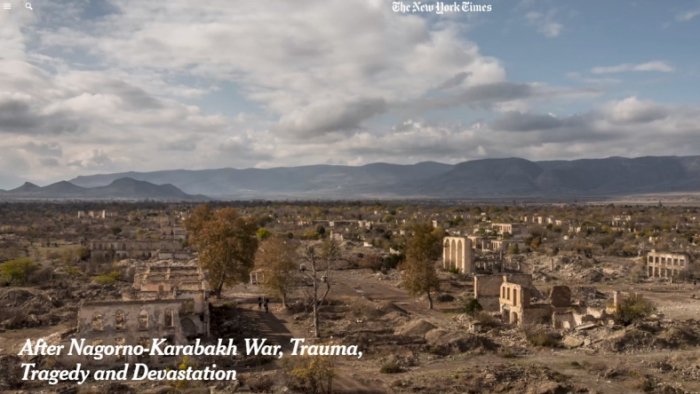
"The New York Times" has published an article by Carlotta Goll, head of the Istanbul bureau of this publication, entitled "After Nagorno-Karabakh War, Trauma, Tragedy and Devastation." Goll visited the territories liberated from the Armenian occupation and got acquainted with the terrible situation during the 30-year aggression of Armenia against Azerbaijan.
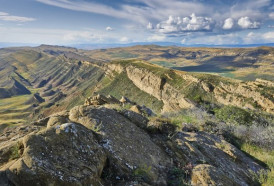
"Crossing into territory that Azerbaijan recently recaptured from Armenia is a journey into a devastated wasteland reminiscent of a World War I battlefield. The road passes miles of abandoned trenches and bunkers, and village after village of ruins, the white stones of homesteads scattered, every movable item — roofs, doors, window frames — picked clean," the writer notes.
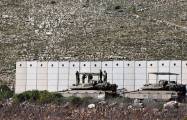
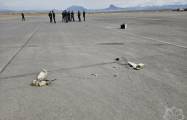
"Wrecked Armenian tanks and armor lay beside the road and in hilltop positions, testament to the devastating power of Azerbaijani drones. Abandoned uniforms and equipment signal a panicked retreat by Armenian soldiers as Azerbaijani forces seized control of the district in early November.
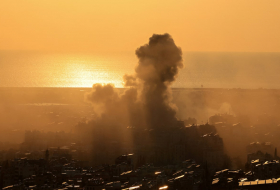
The article also reads: "Decades after the surrounding territory was seized by Armenia, the town of Fizuli, once a prosperous agricultural settlement of some 30,000 people, has become a forest, its ruined public buildings smothered by trees and undergrowth. The fate of the larger town of Aghdam, further north, is even more stark, its buildings split open to the skies on a desiccated plain, its main bridge destroyed."
"The conflict over Nagorno-Karabakh, an ethnically Armenian enclave within Azerbaijan, has been one of the world’s most intractable territorial disputes. A six-year war ended in 1994 with Armenia claiming not just Nagorno-Karabakh but also great swaths of surrounding territory, and driving more than 800,000 Azerbaijanis into exile.
Azerbaijan regained control of Fizuli and Aghdam, part of the territory that Armenia had controlled, after six weeks of a blistering military offensive that ended with a Russian-brokered truce. Most of the core of Nagorno-Karabakh remains in Armenian hands, patrolled by Russian peacekeepers," the author writes.
The author wrote about devastation in Aghdam and Fuzuli regions.
“Azerbaijan’s officials have pledged to offer reconciliation and equal status to Armenians living on its territory. Some Armenians now acknowledge that opportunities for a lasting peace were lost over decades of halting and unproductive peace talks. Mediators tried to at least allow Azerbaijanis to return and resettle some of the outlying districts such as Aghdam and Fizuli. But for years Armenia held on to them, seeing them as a bargaining chip for independence or secession for Nagorno-Karabakh. Azerbaijan’s leaders considered, but in the end never could agree, to letting go of Nagorno-Karabakh,” the author said.
The deadlock was complicated by Armenian politicians and activists around the world increasingly taking the position — disputed by Azerbaijanis — that all of the captured lands were rightfully Armenian. And when Prime Minister Nikol Pashinyan traveled to Nagorno-Karabakh — known in Armenia as Artsakh — in August 2019 and declared that “Artsakh is Armenia,”.
For years, foundations funded by members of the Armenian diaspora have pushed for Armenian settlement of the occupied regions of Azerbaijan outside the core of Nagorno-Karabakh, arguing that they are also Armenia’s rightful lands, the author wrote.
You can read the original article HERE.

-1780923278.jpg&h=190&w=280&zc=1&q=100)