Alternative energy has been a topic of public interest in Azerbaijan, especially for smallholders and villagers. One can’t help but wonder what opportunities such small enterprises in agriculture and smallholders have in order to transition to alternative energy.
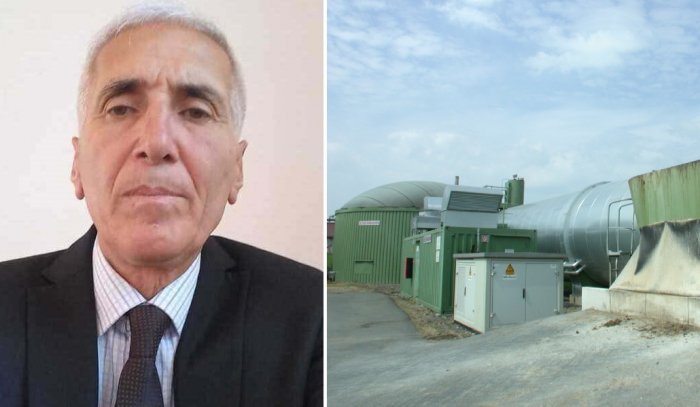
Jamshid Guliyev, ecologist and an active consumer of biogas plants, has explained to AzVision.az that generating alternative energy requires innovative plants, such as solar panels, one of the most popular devices globally.
The expert believes the key to enjoying alternative energy in abundance is to be the producer of such installations, while Azerbaijan is still only a buyer for both solar batteries and panels. ‘The production in Türkiye is still at early stages and other Turkic states cannot boast a production either. China acts as the cheapest exporter for Azerbaijan when the need arises. Neither Türkiye nor Azerbaijan has made much headway in wind energy production, either.
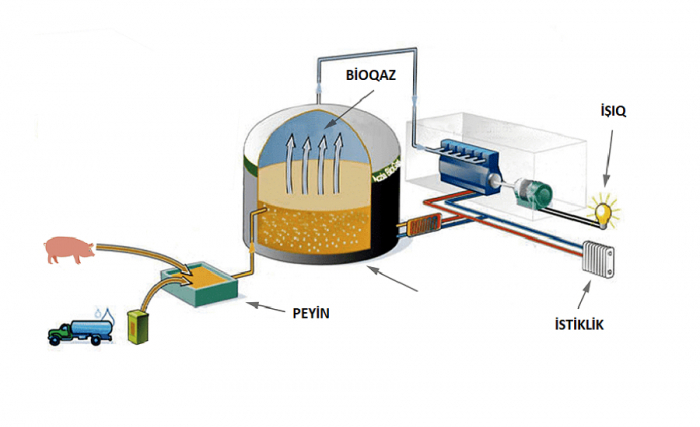
Thermal energy is not a practical field, since the world does not consume it widely. Generating alternative energy through biogas plants whereas is not fraught with dependence on factory-made devices. We can apply the method with home-made or locally produced equipment. Biogas energy is produced when biomass, such as food or animal waste, is broken down and fermented in a reactor at a certain temperature in the absence of oxygen. This process is called anaerobic digestion. The activated microorganisms during such digestion produce methane gas. The gas is very similar to the natural gas we use in everyday life. Methane is very similar to propane or ethane as a combustible gas, but it is relatively heavier. Combustion of methane generates more energy and heat.’
Jamshid Guliyev says that manure, disposed of in livestock farms or sometimes used as a fertilizer, can practically be a raw material in methane gas production. Manure is mixed with waterbefore being placed in a reactor.
‘The reactor must maintain a certain temperature regime. It is regulated based on microorganisms to be activated in the device. The psychrophilic regime is intended for psychrophilic bacteria which do not require high temperatures to survive, which is why it is considered the simplest regime. But there are other microorganisms, mesophiles, that can be used to generate methane. These are activated at higher temperatures. Thermophiles, on the other hand, are activated at 50-52 degrees. Each of these microorganisms, in short, need their own regime to grow.
Maintaining high temperatures in biogas reactors in winter is rather challenging and it becomes even more so in terrains that require more fuel to operate the device, such as mountainous regions. The low degrees outside in winter requires more energy to maintain the necessary temperature. The farmer ends up using the generated gas back to keep up the production of more gas. It simply is not worth the effort for farmers. The best option is to keep psychrophiles at appropriate temperatures to generate cheaper gas. Best practices confirm that operating a biogas plant at low temperature regimes is the most feasible. These plants must also have a certain insulation.
I have also tested adding other equipment to the device and installing automatic and semi-automatic modes to regulate the temperature inside the reactor. Most of these devices are available for order, without having to transport any devices for the biogas reactor from abroad.’
The expert explains that a five-ton reactor produces around 1.2-1.5 cubic metres of gas while operated at low and medium temperature regimes, which is considered sufficient to cover average household consumption, including heating during winter. It might not be sufficient for a facility or apartment with larger demand, which would require a bigger reactor. But would it be worth it for farming?
‘These devices are considered feasible for agriculture and farming; however it might pose a challenge. Preparing the biomass, loading it into the reactor, and maintaining the biogas plants require additional human labour. Operating a biogas plant is not a singlehanded enterprise for any farmer. Therefore, most of them prefer to use the natural gas provided by the state, without compounding their workload with biogas production.
On the other hand, producing biogas is beyond simply economic gain or cheap heating. The benefits the device has to offer for the humanity overall are paramount.
The first would be the utilization of manure at livestock farms. Decomposition outdoors releases carbon and methane into the air, which adds to the already substantial carbon emissions. The release of high amounts of such wastes into the atmosphere changes its structure rapidly, a major cause of the greenhouse effect and climate change. Biogas plants, meanwhile, are offering a beautiful method for their utilization. We end up preventing the methane release and benefitting from it as a fuel. The overall advantage is worth the challenges of operating one.
Secondly, the manure used as raw material for the reactor turns into biohummus, the most valuable fertilizer. Farmers who have tested it on their lands know how useful it can be. I have personally poured a bucketload of it at the base of a tree that hadn’t bloomed for years and watched it bear fruit again. Shortly, we end up also having a rather useful byproduct. There is no need to explain how different it is from chemical fertilizers. Ultimately, even if biogas plants may quite be a challenge for smaller farmers, the device would end up being feasible.
At the same time, I am convinced that peasants shouldn’t be burdened with pioneering the field. As the entire society will benefit from the results, either the state or relevant organizations should shoulder responsibility. International organizations or donor agencies striving to solve environmental problems could undertake some of the financing. The only downside to this is that these organizations are not always as charitable as they seem; they come with their own interests and politics…
Every state should organize the financing and implementation of biogas plants locally. The farmers would then find it encouraging to take upon the challenge of pioneering the field. The benefits are bountiful: free fuel, blooming gardens, clean energy, a more natural fertilizer to use in farming as a byproductto name a few. The field needs more promotion, because the only reason why the plants have not already been widely spread among farmers is the lack of information and reluctance to shoulder the challenge.
If the state acts as the catalyst in the field initially, the end results would boost farming, benefit society in every way and lead to less carbon and methane emissions
More about:




-1780923278.jpg&h=190&w=280&zc=1&q=100)