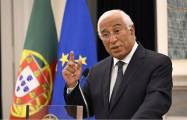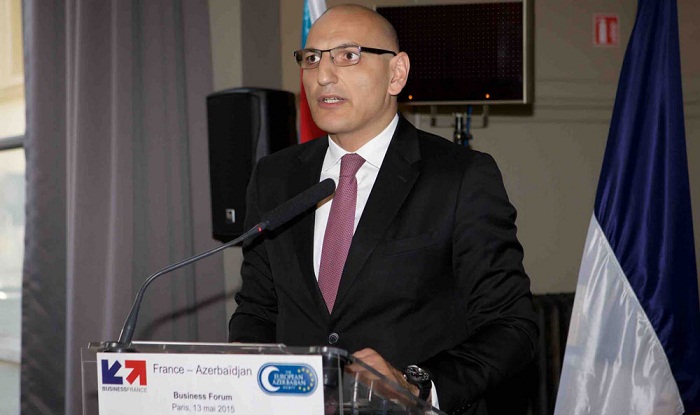
He stressed that Armenia’s annexation of the occupied Azerbaijani territories or creation of a second Armenian state there is unimaginable.
The diplomat said that the three co-chair countries of the OSCE Minsk Group—France, the United States, and Russia—are mediating the peace process, and that the group is working to find a solution acceptable to both Azerbaijan and Armenia.
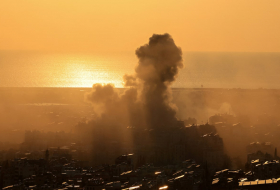
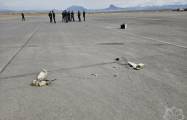
The clashes in early April showed that the status quo, which has resulted from the occupation, is unacceptable and thus cannot last long, Amirbeyov noted.
“It’s quite obvious that the balance of power in political, economic, demographic and military terms has changed a lot in the region since 1994. The situation is different than two decades ago. So it’s wrong to think that Azerbaijan is going to tolerate the occupation of its territories,” he said.
The ambassador underlined the importance of concrete steps in terms of the changing the status quo.
“According to the mediators’ plan, first the districts adjacent to Nagorno-Karabakh region must be immediately liberated and Armenian armed forces must leave these territories. Communication between Azerbaijan and Armenia, as well as Turkey and Armenia should be restored to ensure the return of Azerbaijani IDPs,” Amirbeyov said.
“The second phase will cover withdrawal of Armenian forces from Lachin and Kalbajar districts, discussions on the determination of the parameters of the corridor linking Armenia with Nagorno-Karabakh. Then the discussions on interim status for Nagorno-Karabakh will be started,” he added.
In the end, Amirbeyov stressed that both communities of Nagorno-Karabakh should be allowed to live together in peace.
“With the conditions of coexistence provided, the predominant Armenian population and the minority Azerbaijanis may well live together. Despite the population are largely Muslim, Azerbaijan is an utterly secular state where people of varying faiths and ethnicities live together in harmony. I think Armenians too will someday benefit from this peace and live alongside Azerbaijanis like other peoples,” he concluded.
The Nagorno-Karabakh conflict entered its modern phase when the Armenian SRR made territorial claims against the Azerbaijani SSR in 1988.
A fierce war broke out between Azerbaijan and Armenia over the Nagorno-Karabakh region of Azerbaijan. As a result of the war, Armenian armed forces occupied some 20 percent of Azerbaijani territory which includes Nagorno-Karabakh and seven adjacent districts (Lachin, Kalbajar, Aghdam, Fuzuli, Jabrayil, Gubadli and Zangilan), and over a million Azerbaijanis became refugees and internally displaced people.
The military operations finally came to an end when Azerbaijan and Armenia signed a ceasefire agreement in Bishkek in 1994.
Dealing with the settlement of the Nagorno-Karabakh conflict is the OSCE Minsk Group, which was created after the meeting of the OSCE Ministerial Council in Helsinki on 24 March 1992. The Group’s members include Azerbaijan, Armenia, Russia, the United States, France, Italy, Germany, Turkey, Belarus, Finland and Sweden.
Besides, the OSCE Minsk Group has a co-chairmanship institution, comprised of Russian, US and French co-chairs, which began operating in 1996.
Resolutions 822, 853, 874 and 884 of the UN Security Council, which were passed in short intervals in 1993, and other resolutions adopted by the UN General Assembly, PACE, OSCE, OIC, and other organizations require Armenia to unconditionally withdraw its troops from Nagorno-Karabakh.
More about:

-1780923278.jpg&h=190&w=280&zc=1&q=100)