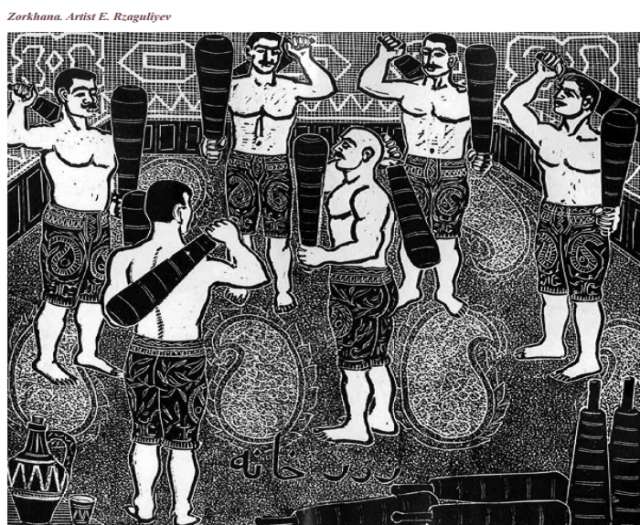
One of these priceless monuments of material and spiritual culture is Zorkhana. “Zor” means strength or power in Azerbaijani, and the particle “Khana” means “house” or “place”. These “houses of power” represented a structure with a small dome in the middle of the roof.
After the capture of Persia by the Arabs in the 7th century, participants in the national liberation movement led by Abu Muslim Khorasani, preparing to fight, went to the mountains of Khorasan, where they had special training in special shelters - a kind of secret clubs.
In the later period, the spread of zorkhana and the development of the national struggle belong to the era of the Azerbaijani Safavid state and are directly connected with the name of its founder Ismayil Khatai.
The time of continuous confrontations and ongoing wars required bold, hardy and strong people. An important role in military operations was played by pahlavans – strong men, and therefore, special attention was paid to their training.
So, a kind of sports clubs of the time – zorkhanas, where constant workouts were conducted, began to appear in the cities. Competitions were organized in which each city determined its own pahlavan. The pahlavans enjoyed universal respect, were equated to public people and even received salaries.
Under the Safavids, along with government officials such as mollabashi - head of the clergy, munajjimbashi - chief astrologer and khazinadarbashi - chief treasurer, there was the post of pahlavanbashi, i.e. heads of strong men. At that time, zorkhanas were very common and opened in each mahalla – a neighborhood run by local elders.
In addition, zorkhanas for competitions were available at the homes of judges and nobility.
Zorkhanas served as places of workouts and pahlavan competitions. Rules of wrestling were aligned with the rules of zorkhana.
Zorkhanas with characteristic domes operated throughout Azerbaijan - Baku, Ganja, Shusha, Sheki, Nakhchivan, Ardabil, Maraga, Khoy and Urmiya.
The Baku zorkhana was one of the most famous ones. It was founded by Shonu Abdullah in the early 19th century, and he dedicated his entire life – and he lived for 116 years! - to this cause.
In the Baku zorkhana, pahlavans whose names were a talking point - Muhammad Huseyn, Altiaylig Abdulali, Hileli Pahlavan, Ali Hummat, Muhammad Hanifa, Zorba Rzagulu, Jero Suleyman and others - trained and wrestled.
The anti-colonial struggle, which intensified in the late 19th century, spread throughout the Caucasus. Therefore, for fear of popular uprisings, the authorities began to close traditional crowded places.
In 1893, they closed the Baku zorkhana, in which about three hundred spectators gathered every night. But despite the prohibitions, new zorkhanas appeared in Baku in the following years.
Usually, the premises of a zorkhana were slightly below the ground level. In the center of the site there was a hollow with a depth of one meter and with a length and a width of 10 meters, which was called “Sufra”.
The hollow was filled with dry grass, ash and fine sand. The sufra was renewed every few years. Before workouts, this place was watered to prevent dust.
Training in zorkhanas began with dance workouts to lift morale. Then they played games with heavy shells that helped develop agility, endurance and coordination. At the very end, they held a contest - fights of pahlavans.
Depending on the nature of games, from 20 to 25 people trained in the zorkhana. Special places were allocated to viewers around the sufra.
The entrance to the zorkhana had a height of 1.5 meters or less – this was done for visitors to bow down at the door and in such a way, albeit unwittingly, show respect and reverence for the zorkhana.
At the head of the sufra, the murshud - a kind of head of the zorkhana – sat at a height of 1 meter. Above his head hung a small bell, which was used to signal the beginning and end of a game and to prevent violations.
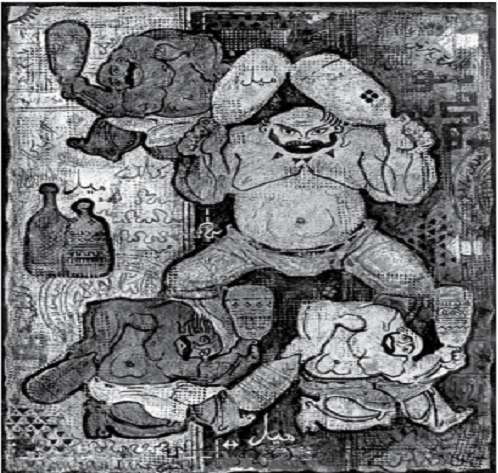
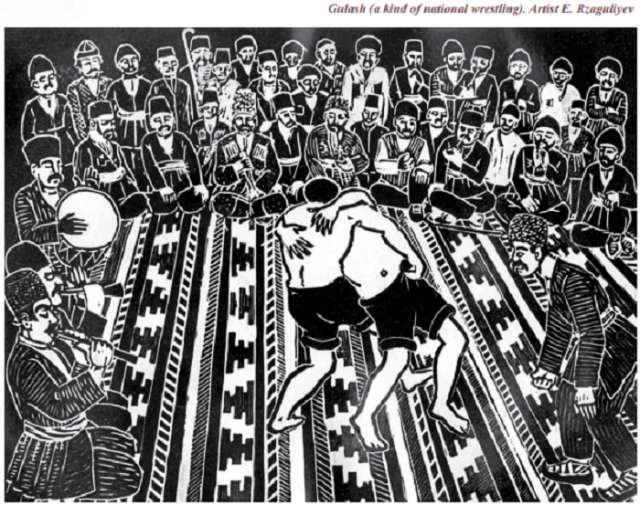
Near the murshud, a musician with a dumbul – a percussion instrument made of ceramics and upholstered in leather, sat and accompanied the action. Here, a fire designed for heating the dumbul burned constantly in the brazier. Different herbs were thrown into the fire to improve the air inside.
In the later Middle Ages, the duties of the murshud and the musician began to be performed by the same person. Some of the functions of the murshud were performed by a miyandar, who stood in the middle, and following his signal, they began a workout to the accompaniment of the dumbul. In some cases, except for the dumbul, the gosha-zurna and balaban were also played in the zorkhana.
Participants in the zorkhana wore a special uniform, the so-called tenban. “Tenban” trousers were initially made from Russian leather, and later from thick fabric or leather. The surface of the tenban is decorated with various patterns.
Training in the zorkhana included 6 (according to other sources - 9 games - “sino”, “yekpa”, “mil”, “kabbadeh”, “yekbargir”, “charkhi”, and a fight was arranged at the end. Some games were conducted with the help of special tools. For example, for a warm-up for the “mil” game two wooden sticks were used, which weighed from 12 to 30 kg together.
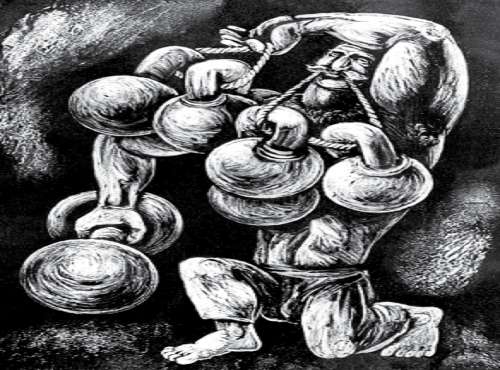
To the accompaniment of music, pahlavans-strong men rotated these tools over their heads, and some, in order to impress the audience, threw and caught these sticks.
The kabbadeh was a metal tool weighing 14-15 kg, while the yekbargir was a tool with a handle weighing at least 60 kg. Depending on the nature of the games, wrestlers lifted and rotated these items 40-50 times during the warm-up, exciting the audience with their strength.
At the end of the game “charkhi”, athletes began to move at a rapid pace along the edges of the sufra. This meant the end of the warm-up and the imminent start of the next phase - wrestling fights. This transition was accompanied by merry tunes.
The fights started after a break. Preparing to fight, pahlavans threw down a kind of gauntlet to their opponent, reciting some verses. The fight was carried out according to the rules of zorkhana to the accompaniment of music under the direction of the murshud and under the supervision of the miyandar. Apart from them, two pahlavans could serve as judges. After finishing the fight, the pahlavans kissed the hand of the murshud and left the sufra.
-1780923278.jpg&h=190&w=280&zc=1&q=100)