“A few months ago, there would be a maximum of 70 people in the lines; now we have 500 people queuing. We started running out of food about three weeks ago,” said Marie Eisendick, who has helped run the Refugee Community Kitchen since the beginning of the year.
It was no longer possible to provide a hot meal for everyone who wanted one, and hungry people had to be turned away regularly, she added, describing the absence of better assistance from the UK and French authorities as “scandalous”. “We have the same resources and staff that we had three months ago, but there are thousands more people to feed.”
Latest census figures show a 30% increase in the camp’s population in a month, bringing the total number to more than 9,100. About 70 new people arrive every day, with large numbers coming from Sudan and Afghanistan. Volunteers say they do not have enough tents and blankets to hand out to new arrivals.
The fresh crisis came as France’s interior minister, Bernard Cazeneuve, said the camp would be gradually dismantled and accommodation would be created for thousands elsewhere in the country “to unblock Calais”.
Longer lines are visible at all four distribution points, run by different charities in the camp. The long wait for food has led to rising tension in the queues, with arguments breaking out over queue jumping. “People are very worried they will not get any food. People tell us that they are hungry,” Eisendick said.
By 11.30am, a distribution caravan dispensing tents and blankets had no more supplies, and new arrivals were turned away. “We only have 30 blankets to hand out a day. We can’t help any more people. We’d love to be able to help, but it’s finished,” a volunteer shouted, attempting to disperse a crowd of disappointed arrivals.
The struggle to feed the camp is partly the result of the absence of an official international aid agency overseeing the worsening conditions, which has forced smaller volunteer-run agencies to step in. These organisations rely on donations, which fluctuate wildly according to public awareness of the situation. Reports that the French authorities had bulldozed most of the camp in the spring led to a rapid fall in donations, but the number of refugees who have returned to live in tents and shacks has risen steadily, and 4,000 more people now live there than at the start of the year.
“There is a sense that the refugee crisis is over in Calais, when it’s actually the reverse,” Eisendick said. “It angers me that a really small organisation like ours is carrying the weight of this problem without the support of the French or the British government, or bigger aid organisations. People aren’t starving here, but they are hungry because there isn’t enough food. That’s a scandalous situation to have in France.”
Calais Kitchens, another organisation that distributes emergency food parcels to residents, has had to reduce the size of rations in the past month to balance growing demand against dwindling resources. “There is some donor fatigue. We no longer have the money to buy the food we need to distribute,” Fee Gerlach, a volunteer, said. “In the last two weeks, I’ve had conversations with people about hunger; in the seven months I’ve been here that hasn’t happened before.”
Inside Calais Kitchens, which is providing bags and meals for the ever-expanding population in the Calais camp. Photograph: Teri Pengilley for the Guardian
Increasing numbers of refugees are choosing to claim asylum in France, rather than continue to wait in limbo in the camp, risking their lives attempting to travel illegally on lorries to the UK. Volunteers are actively promoting France as an attractive destination and are at pains to persuade people that France is not all like Calais (a place of mud and open sewers, with no electricity or running water), but a better place, with sanitation and houses with roofs.
“I can’t speak French, I don’t think they like refugees here, but I have applied to stay here. Trying to get to England is very difficult,” a 19-year-old man from Afghanistan, who has been in the camp for six months, said as he queued to see a camp volunteer nurse about a chest infection. The asylum application process was slow, and so he remains stuck in the camp waiting for a decision.
Much of his life is punctuated by queuing. Waiting in line for clothes distribution can take more than three hours now that the camp is so full. “It is more difficult with food now. You can stand for hours waiting; it makes people want to fight,” he said.
Some elements of camp life are easier in the summer. A concerted campaign to remove rubbish has alleviated a rat infestation. The paths that run through the camp are no longer waterlogged, but attempts to move people from flimsy donated camping tents into sturdier wooden huts have been frustrated by a ban on building materials. Although refugees have attempted to improve tents by insulating them with extra layers of plastic and tarpaulin as well as knitted blankets, everyone knows they will offer scant protection once the cold weather returns.
Calais refugee camp running out of food amid donor fatigue
04 September 2016
Read: 1282
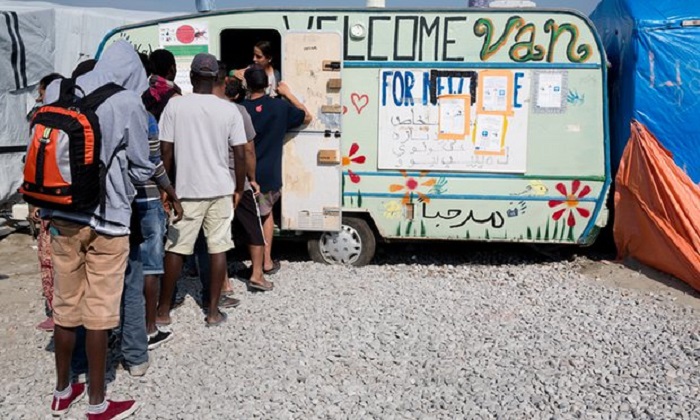
Charities are warning that they no longer have enough donated food or money to feed the rapidly growing population of refugees in the camp in Calais, with supplies running out on a daily basis and migrants reporting they are going hungry, AzVision.az reports citing TheGuardian.


-1780923278.jpg&h=190&w=280&zc=1&q=100)