Almost all privileges were cancelled by a presidential decree “On ensuring replacement of privileges for utilities, transport and other services by benefits”, dated 26 December 2001, they were replaced by allowances.
According to the "Rule of substitution of the privileges of the unsettled refugees and internally displaced persons by benefits and their payment" approved by the decision, dated 22 January 2002, of the Cabinet of Ministers, the State Committee for Work with Refugees and IDPs started to repay for utility, transport and electricity expenses of these people to the relevant bodies in a centralized rule.
Under the decision of the Cabinet of Ministers “On approval of minimum consumer basket”, dated 23 June 2005, 50 kWh of free electricity was provided per person per month and under decision, dated 22 January 2002, 150 kWh of free electricity was provided for unsettled refugees and internally displaced persons per person per month.
However, the Chamber of Accounts revealed major deficiencies, embezzlements and costs exceeding the limit while inspecting the issues on solution of social problems of refugees and IDPs, as well as utility costs. For example, funds allocated to Bakielektrikshebeke OJSC in 2012 were not in compliance with the approved number of consumers, the number of IDPs was recorded more in some districts. Some of them were presented as registered in several districts. In 22 cases, more funds were allocated to relevant bodies due to inaccurate counting of IDPs in newly-built settlements. Inspections revealed embezzlement of 283,200 manats of budget funds and tax evasion of 267,000 manats.
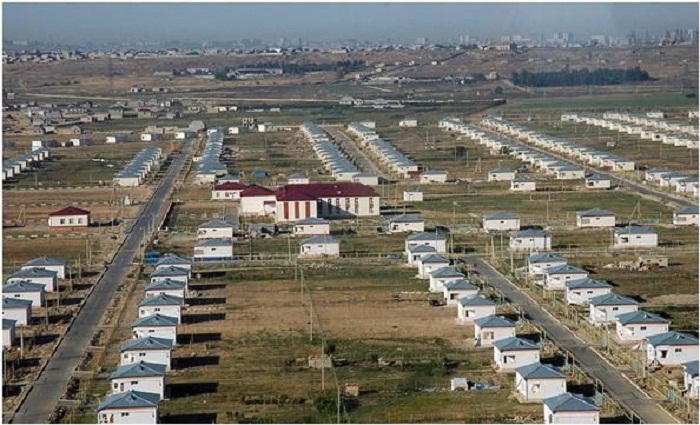
The results of the audit conducted by the Board of the Chamber of Accounts in connection with forecasting and utilization of funds allocated from the state budget in the years 2014-2015 and in the first quarter of 2016 to the State Committee for Work with Refugees and IDPs and the subject structures show that the problem continued in years that followed. The audit measure covered a total of AZN 560.2 million on the State Committee subordinate structures. 38.8% of disbursements accounted for the cost of utilities and communication services and 47.7% included benefits paid to them. It was found that the measures taken in connection with the elimination of deficiencies identified in the results of the previous audit activity of the State Committee for 2008-2011 are insufficient and that the same flaws existed in the current period covered by audit. It turned out that the budget allocated in the respective order from the state budget to pay off the monthly electricity consumption per capita are high, and in homes where there were electric meters, the payment was made not on actual consumption but on regulatory indicators. It was also found that the amount of electricity actually used by refugees and IDPs in their places of temporary residence is much higher than the volume of electricity consumed by the local population. According to information received from the service providers, in all districts and cities of the country the average electricity consumption of the local population is 60 to 80 kWh, and the rate of energy consumption of beneficiaries is 150 kWh, which corresponds to the volume specified in the regulatory act. This trend also remained unchanged at the time the gas supply in the country expanded. In villages populated by refugees, the title list was not made up of the number of electrical outlets, regularly swept areas, garbage collection route, and the fault acts of apartments needing repair, which lead to higher payments.
The results of the audits conducted by the Chamber of Accounts indicate that there has been a serious exaggeration in the payments required from the people of this category, and the executive structure of the areas where IDPs live were also actively involved in the process.
Commenting on this issue MP Chingiz Ganizade told that the Azerbaijani president has always paid attention to the issue of refugees and internally displaced persons and has signed numerous decrees and orders in order to strengthen their social protection as well as their settlement solutions and employment problems. Relevant state programs have been implemented. This process has been ongoing for 25 years, which is virtually a quarter of a century. Over the past 25 years, the living standards of refugees and internally displaced persons have risen substantially as a result of attention and care of the state. The housing problem has been solved of the majority of people of this category. However, a small portion of these people still live in dormitories and other places. Utilities, transportation and other expenses of refugees and internally displaced persons as well as expenses for electricity consumption are paid to relevant bodies in a centralized manner. However, the results of the audits conducted by the Chamber of Accounts revealed that there is a great difference between the numbers of IDPs provided with electricity and those who made payment for water, gas, sewage and household waste transportation services. Such a question arises that if 100 refugees and IDPs are paid funds for electricity in a centralized manner, why the payments made for water, sewage and household waste transportation services differ? It means that there is still a human factor, and inclination to corruption and embezzlement. And all these cause great damage to the state budget. In this respect, I think that benefitsfor IDPs and refugees should be further improved, funds should be further allocated to them for utility costs on a targeted basis and they in turn should directly make the payments to relevant bodies”, he said.
The MP offered the decision, dated 22 January 2002, of the Cabinet of Ministers to be reconsidered: “This will lead to disqualification of executive bodies which unnecessarily function between the state and citizens from the payment process and elimination of the factor which leads to corruption and other negative cases,” he added.
MP Hikmat Babaoghlu told that it will be more appropriate that funds should be allocated to IDPs and refugees for utility costs on a targeted basis and they should directly make the payments to relevant bodies. Babaoghlu stressed that the results of the audits conducted by the Chamber of Accounts make it necessary to take such a step.
The MP called for the reconsideration of the status of refugees and IDPs.
“These people have been living under the ‘status of refugee’ for 25 years and how long it should last? In fact, complex measures were taken in the last period regarding the solution of their problems related to social security, housing and employment. All tent camps have been removed in the country, new settlements with modern infrastructure have been built and many refugees and IDPs have been provided with houses and apartments. The rate of unemployment among refugees and IDPs has reduced to 15%. During the 25 years, those people gave birth to children, got education and worked in different state agencies. Given all this, to what extent it will be reasonable to maintain the status of refugees and internally displaced persons? This status restricts their life activity as full-fledged citizens and causes them to feel isolated from the social legal system of the society. The status of refugee and internally displaced person has become a factor that hinders full integration of those people to society and their active involvement in the country’s socio-political, socio-economic and cultural life,” he added.
The MP also proposed to reconsider the law “On status of refugees and internally displaced (persons displaced within the country) persons”, dated 21 May 1999.
/APA/
More about:

-1780923278.jpg&h=190&w=280&zc=1&q=100)