Almost 100 inmates lost their lives in the first week of January alone - brutally murdered, the guards apparently unable to stop the bloodshed.
But how has it come to this?
A crackdown on violent and drug-related offences in recent years has seen the prison population soar since the turn of the century.
In 2014, there were 622,202 people imprisoned in Brazil, the fourth highest total globally after the US, China and Russia. In 2000, there were just 232,755 incarcerated in the South American country.
The increase has put pressure on Brazil`s 1,424 detention facilities, which are running at 157% capacity, according to The World Prison Brief.
The problem of overcrowding is made worse by a lack of resources. Camila Dias, a sociologist at the Federal University of ABC in Sao Paulo and expert on Brazil`s prison system, told Reuters that even in the relatively wealthy state of Sao Paulo, a single guard oversees 300 to 400 prisoners in some prisons.
That means it is relatively easy for prisoners - and gangs - to take control of the facilities.
As a result, "when the prisoners want to have an uprising, they have an uprising," Ms Dias said.
Gang warfare
Killings are already common within the walls of Brazil`s prisons - 372 inmates lost their lives in this way in 2016, according to Folha de Sao Paulo newspaper - but this recent surge has been linked to the breakdown in a two-decade truce of sorts between the country`s two most powerful gangs.
Up until recently, the Sao Paulo-based First Capital Command (PCC) drug gang and Rio de Janeiro`s Red Command had a working relationship, supposedly to ensure the flow of marijuana, cocaine and guns over Brazil`s porous borders and into its cities.
But recently they have fallen out - although the exact reasons why remain unclear.
And thanks to the government`s crackdown on criminal gangs, there are thousands of members of both gangs locked up inside Brazilian prisons.
Rafael Alcadipani, a public security expert at the Getulio Vargas Foundation think tank in Sao Paulo, told Reuters it means any feud between the two sides on the streets will almost certainly spill over into the largely "self-regulated" jails.
"We see that as soon as we have a gang war, these killings are inevitably going to happen because the state has no control over the prisons," he said.
However, the government is acting to try and regain control over its prison population.
Following the 1 January riot, which left 56 inmates dead in a prison in Manaus, in Amazonas state, the government announced a plan focusing on reducing in the number of cases of manslaughter; combating organised crime inside the jails, including transnational organisations that smuggle in drugs and weapons; and the modernisation of the prison system.
Funds have also been announced for five new high-security jails, with Justice Minister Alexandre Moraes calling for the way minor offences are sentenced to be looked at, in order to try to reduce the number of people receiving prison sentences.
/BBC/
Why are Brazil`s prisons so violent?
07 January 2017
Read: 1519
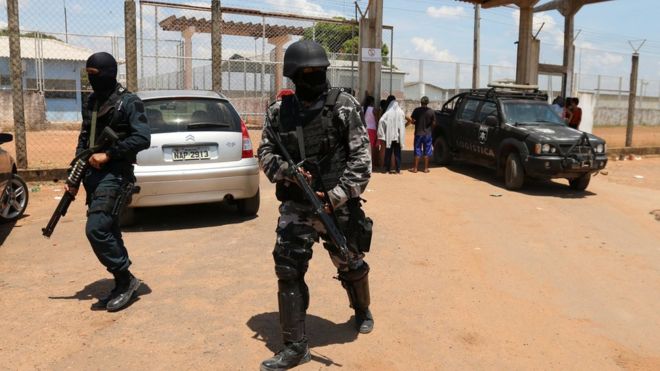
A spate of violence in Brazil`s prisons has cast a spotlight on a system which appears to be near a state of collapse.



-1780923278.jpg&h=190&w=280&zc=1&q=100)